
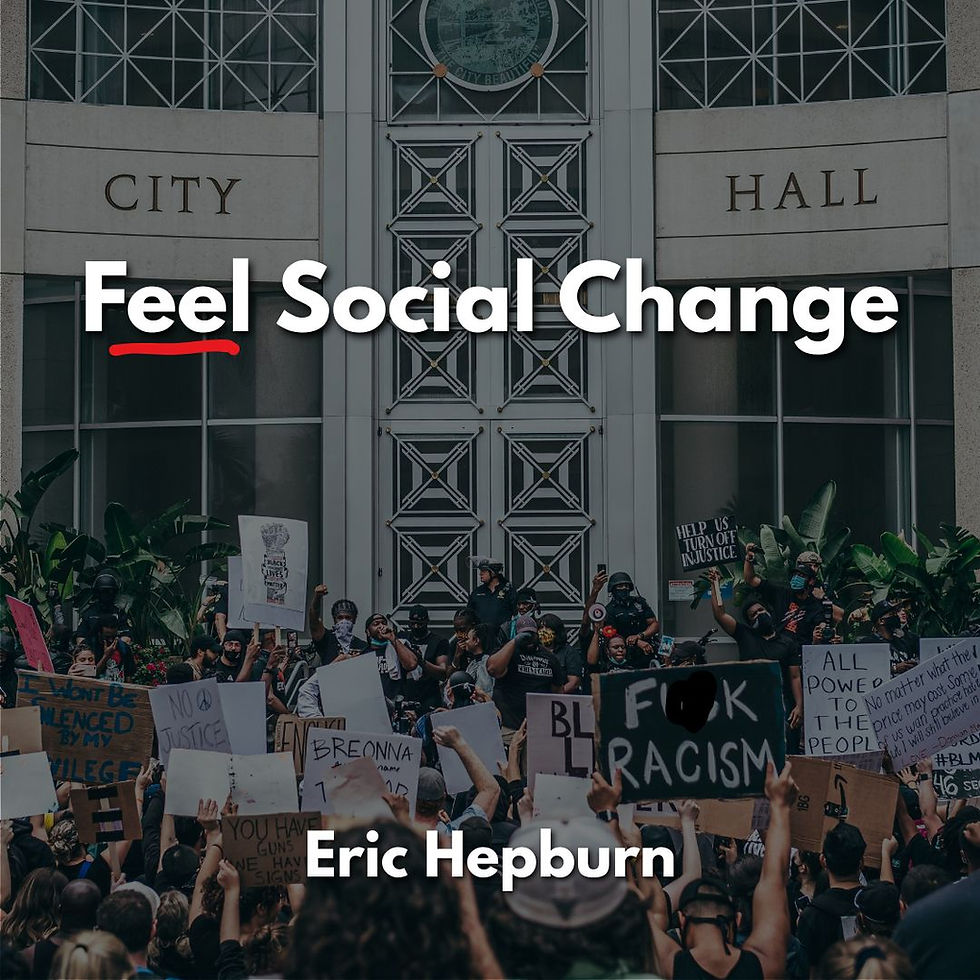
Feel Social Change: Caregivers, Healers, and the Enneagram's Feeling Triad by Eric Hepburn

Updated: Jul 21
July 12, 2026 - The second sermon in a four-part series reading Deepa Iyer's social change ecosystem — from her book Social Change Now, the 2025–26 Unitarian Universalist Association common read — through a developmental lens drawn from the Enneagram's centers: gut, heart, and head; plus spirit.
This episode turns from gut to heart: the feeling triad, whose underlying struggle is shame, and the two ecosystem roles where heart energy finds its work — Caregivers and Healers. Along the way: Brené Brown's distinction between shame ("I am a bad thing") and guilt ("I did a bad thing"), the oxygen-mask problem of self-care for people who pour themselves out, a river parable that separates the caregiver's call from the healer's, why the ecosystem view frees us from ranking our role above anyone else's, and how the one-year anniversary of the July 2025 Texas Hill Country floods shows both roles at work in Kerr County today.
Pulpiteer Podcast Transcript: Season 3, Episode 2
Lightly edited for readability: transcription errors corrected, filler words reduced, punctuation repaired. Bracketed items are editorial.
[00:00:00] Eric Hepburn (host intro): Welcome to the second episode of the third season of The Pulpiteer. I'm your host, Eric Hepburn, and I'm glad to have you join us for today's episode. Today's episode is called "Feel Social Change," and it's the second of a four-part series exploring the social change ecosystem work of Deepa Iyer through the lens of the Enneagram triads. We'll begin with our Great World House segment, then our Voice of Wisdom, read by Keith Hutchinson.
The Great World House — Eric Hepburn
We now pause to honor the Great World House, of which we are a part — lifting up the needs, the hopes, and the voices beyond these doors.
One year ago last weekend, the rivers of the Hill Country rose in the night. More than one hundred and thirty of our neighbors died — in Kerr County, along the Guadalupe, and closer to home as well. The nation watched for a week. The frontline responders — we talked about them last Sunday — did their brave and urgent work. Then the cameras left, and the other work began. The year-long work.
This anniversary week, the news from Kerrville isn't about rescue. It's about the one hundred and thirty families who are back in their homes, and the counselors still sitting with children who are learning to sleep through the rain. There's a campaign there now, in Kerrville, with the most Texan name imaginable: "Y'all okay?" Neighbors checking on neighbors, one year in, because somebody has to keep asking after everyone else stops.
Austin Dickson, who leads the Hill Country's relief foundation — a man who lost his own loved ones in the waters that night — said it this way: "You can be in grief and you can also be hopeful at the same time. And that's very much where I am, personally."
And that is the work of caregivers and healers. It doesn't trend. It tends. And it is holy work.
So hold the Hill Country in your hearts this morning — the grieving and the mending alike.
A Voice of Wisdom — read by Keith Hutchinson
After the words are spoken, we will breathe together in silence, until the ringing of the bowl calls us onward, into the space where the Word unfolds among us.
We welcome this Voice of Wisdom, carried through Don Riso and Russ Hudson:
"We seldom dare to be fully in our hearts. When we are, it is often overwhelming. We therefore substitute all kinds of reactions for the power of real feelings. This is the core dilemma of the feeling triad.
"For heart triad people, at the deepest level, your heart qualities are the source of your identity. When your heart opens, you know who you are, and that 'who you are' has nothing to do with what people think of you, and nothing to do with your past history. You have a particular quality, a flavor, something that is unique and intimately you. It is through the heart that we recognize and appreciate our true nature.
"When we are in contact with the heart, we feel loved and valued. Moreover, as the great spiritual traditions teach, the heart reveals that we are love and value. Our share in the divine nature means not only that we are loved by God, but that the presence of love resides within us. We are the conduit through which love comes into the world."
The Sermon: Feel Social Change — Eric Hepburn
We are the conduit through which love comes into the world.
That quote continues: "But when our hearts are closed and blocked off, however, not only do we lose contact with our true identity, but we don't feel valued or loved."
Okay — before we dive in this week, I'm going to do a quick recap from last week. We talked last week about the instinctive triad — the part where our motivational energy comes from the gut and the body. The concern of the instinctive triad is resistance and control of the environment, and I think you can see how that surfaced in our three roles: our Frontline Responder, our Disrupter, and our Experimenter roles. People from the instinctive triad are seeking autonomy, and — as we discussed at length last week — the underlying feeling they struggle with the most is anger and rage. So we talked about: if you recognize that anger and rage in yourself, these pathways are ways that you can metabolize that rage into healthy, pro-social, pro-spiritual behavior.
Today, we're talking about the feeling triad. For those Enneagram nerds among you, that's the Two, Three, and Four Enneagram numbers. I'm going to start by centering the underlying feeling, just like I did last week. The underlying feeling for feeling types — the thing they struggle with — is shame. We're going to get into that, but I wanted to give you a preview of what's coming. They seek attention. Their issues are with identity and hostility. And I think you'll see that a little bit as we talk about it more deeply. The two social change roles that people in this triad get drawn into, in my interpretation, are caregiving and healing.
All right — I do want to issue a correction. A triad is, linguistically, a group of three things. I talked about it last week as if it were a third. In this system of the Enneagram, there are three triads because there are nine categories — so each group of three is both a third of the whole and a set of three at the same time. But I realized the way I spoke about it last week, it sounded like I was defining the word incorrectly, and that made my "I want to be right" part of my brain tickle a little. So I had to do the thing where I issue a correction and not teach you misleading things that get you scoffed at at parties. "Didn't you know that a triad means a third? My minister said that."
Now — if you're already feeling offended by these negative descriptors, I want to remind you that each of these triads, and each of the Enneagram types within them, have positive and negative qualities. We're starting off with the negative qualities not because we want to center that, but because it's where recognition is easiest. It's easiest because of the seven-to-one ratio — the fact that we're seven times more sensitive to negative data than positive data. It makes it easier for you to see where you fit if I describe the negative aspects of the triad instead of the positive aspects.
Because here's what happens — and I've been in rooms where they've tried to do this. I could sit here and tell you the positive aspects of all three triads, and each time you'd go, "oh yeah, that's me. I'm like that on my good days. Totally. I can see myself in there." But when I describe the negative ones, it's not like that. It's like, "oh, that's not me — but I know some people like that." And then, "oh, that's not me either — but I know some people like that." And then it's like, "oh... what's that word that was up there? Shame." And the shame starts. "Oh, that's me." And not "that's me" in an "I'm proud to be me" way — "that's me" in an "oh, you put your finger on the thing I struggle with the most, and therefore it's the scariest" way. That resonance, though, is what helps you find your way. Even though it's uncomfortable.
So: we're talking about the feeling triad. I want to start by unpacking, using Brené Brown's work, the difference between shame and guilt — because for feeling triad folks, this is a core tool for metabolizing shame into the healthier, pro-social emotion of guilt. And probably you're all thinking: "can I have a life with neither of those, please?" Maybe. But that would be a mistake-free life, and so it's unlikely, all things considered.
Shame is the story: I did something bad, and I'm a bad person. That's why I wore this one today [indicating shirt]: "Each of us is more than the worst thing we've ever done." Shame is: "I made a mistake — I said something unkind to my partner, friend, child, spouse, boss — and I'm a bad person because I did that." That's shame. Guilt is: I did a bad thing.
Shame is problematic because the bad thing becomes the identity. The bad thing becomes your identity — and there's no way out of that for you. "Oh, now I just have to accept I'm a lousy person." That's what shame does. And that's the gremlin that sits on the shoulder of feeling-type [Two] folks: the constant worry that they're actually not a good person. That's the thing that haunts them. It's the reason why, when their identities are challenged, they struggle with hostility. They want to show up and do this work, and if it doesn't work, their reaction is, "oh, I guess I wasn't good enough to do that." I don't know — but when I read this, it really resonates with the people in my life who I've known who show up, for sure, as caregivers and healers for others.
Guilt is pro-social because you can recover from it. You can recover from "I made a mistake" or "I did a bad thing" — if you don't adopt it as your identity. It's like: "oh, I did this thing. I now need to make a repair, or an amend, to repair the relationship that was damaged when I did this bad thing. But the bad thing isn't who I am. It's just a mistake that I made. It was something that happened."
So that is the difference between shame and guilt. And if feeling triad folks can amend the stories they tell themselves — from "I'm a bad person" to "I did a bad thing" — they are, as G.I. Joe used to say, halfway there: knowing is half the battle. They're already halfway to a healthier path when they replace the story "I'm a bad person" with the story "I made a mistake."
And the other half of the journey is: "now that I did this bad thing, I have to use that part of me that wants to show up and heal and caregive to ask the question — okay, who did that bad thing impact? How do I start to make a relationship repair? How do I undo the damage? How do I move forward and heal the relationship with the people who were affected?"
And sometimes one of the main people affected by the bad decision is you. And then we have to engage in self-forgiveness, or repairing with self. "Oh — the mistake I made was pretending that I had the energy of seventeen people, and now I'm burned out and run ragged. And the peacemaking I have to do with myself is to give myself permission to go to my boss and say: I need a week off. I'm going to go and rest, and I'm going to have a week where the only person I'm caretaking is me."
This is another big challenge for feeling triad folks: they're real good at taking care of everyone else. They're also on the slip-and-slide to burnout almost all the time. Because while they are super attuned to what's going on with everybody else — ready to zero in and make sure that you have your needs met — they are real bad at pausing and saying, "wait, what are my needs? What do I need in this moment?" They only want to do that when everyone else is all taken care of. Any of you ever had a moment in life where everybody else was all taken care of? Yeah. Neither have they. They've never had that moment. But they're very convinced that just as soon as everybody else's needs are met, they can take care of themselves.
This goes back to a lesson from early in my parenting journey, where the great wisdom of "put on your mask before you help somebody else with theirs" — airplane wisdom — landed for me as a real parenting thing. If you don't put on your own mask, if you're not doing enough self-care, then it's just going to be bad. I could spend three sermons talking about that, but I'm not going to. Today I'm going to spend this one sermon talking about something else.
So — we put on our own mask first. Especially if we're a healing person, that feels challenging. Going back to the shame thing: one of the angles of shame that often gets activated in our healers and caregivers is, "if I know that Chris is in pain, and I don't immediately go help her because I'm busy putting on my own mask, that makes me selfish and a bad person." That's the dynamic. "I know that somebody else out there needs me right this second, and so I can't stop and put on my own mask, because that would make me bad and selfish — to ignore somebody else's pain and take care of myself first." That's the shame trigger. This is the lifelong struggle of feeling triad folks.
But here's the amazing thing: when they learn to set healthy boundaries, they are amazing healers and caregivers. They are amazing — because they're pouring from a cup that overflows. They are so good at channeling love through themselves, they're so good, they'll burn out from it if they don't remember to do their self-maintenance. They'll literally let so much love flow through them that they've got nothing left over, and then they're burned out. But when they learn how to do their conduit maintenance, they can be tremendous fountains of love and care and healing into the world.
So — if y'all are interested in this, you can read the book, but here's how the healer-versus-caregiver distinction lands for me. There's an analogy — it probably started out as an ancient parable or story, but I wasn't able to find it or figure out its origin, probably because I didn't look hard enough. It goes like this.
You come across a river, and floating down the river are injured children — like they've been shot; they've got bullet wounds — and they're floating down the river. And so people immediately, of course, start pulling the children out of the river. And they get bandages, and they start tending the wounds and tending to the needs, and setting up a village and cots so they can heal. And the doctors come, and the nurses come, and all the people from the village go out, and they're pulling these kids out of the water and making sure they're getting food, and water, and their wounds healed up.
That is the caregivers. The caregivers are the ones who say: "immediate need. I need to address the symptom of the problem. It deserves love and attention. Let's go do it right now." They're like the frontline responders of the caregiving-and-healing part of the picture.
Now, the healer role is a little different. The healer is the person who, after doing this for a little while, says: "This is all well and good. These children need love and attention, and they deserve healing. But I've got two problems here. One is: band-aids don't seem like an appropriate response to bullet holes. And number two is: why are there children with bullet holes floating down the river?"
Healers like to ask the deeper question about causation — and then go fix that — as a general rule. Now, this is a metaphor. It's not that they ignore people who are in pain. But even with the people who are in pain: where caregivers tend to focus on symptom relief — and I'm not denigrating that; I want you to hear me, we're going to wrap back to that — healers are like, "yes, but it's going to be all band-aids all day for the rest of our lives unless we ask the deeper question: what's making the pain? What's causing it?"
On an individual basis, that might mean they're like: "sure, let's go out and have coffee, and you can complain to me and tell me how awful things are." But after we've done that once a week for six weeks, they're like: "okay, I'm hearing the same story over and over again. There's something underneath it that we're not surfacing here. And that deeper thing underneath is where the source of the pain is. And we've got to go there."
Now, a caregiver — and this is what happens when caregivers get into therapy roles — a caregiver is very content to just keep doing band-aids. They're like, "oh, honey, if you want to pay me to come and complain to me for an hour a week, or an hour a month, for the next thirty years, I'm cool with that. Here — I've got some salve right here that's just perfect for that. Oh, you poor dear." But healers are not content with that. They're not content with symptom relief. They're like, "what is going on under the hood there?"
Now — you can even hear it in my own way of saying it. Because I too, like all of you, am a deeply imperfect human being. But here's one of the things I want to highlight about Deepa Iyer's work, and why I thought it was worth taking a whole month to talk about it. There is a tendency — and a tension — depending on what kind of person you are, to build a value hierarchy: to rank one role over another, and explain why yours is better. I lean into healing. When I'm active in this triad in my life, I'm leaning into healing work, not caregiving work. I'm like, "yeah, yeah, you're in pain, we're all in pain, I get it — what's causing it?" That's just me. But it also makes it super easy — it makes it an ego trap for me — to denigrate caregivers.
And one of the beautiful things about Deepa Iyer's social change ecosystem work is that it invites us to step back and say: you don't have to do that. You don't have to do the ego thing, where the role you play is more important than everybody else's. By viewing it as an ecology, an ecosystem, we give ourselves not just permission but encouragement to acknowledge the true, real, and beautiful value of how each of these different ways of being and showing up work together.
Because here's the truth. If everybody was like me — if everybody in the village charges up the river to find out who's throwing kids in — all those kids floating down the stream, they die. They die in pain, because there were no caregivers present. And if everybody was showing up with that healer, got-to-get-to-the-root-cause mentality — we need both. We need the people who are going to pull the bodies out of the river and say, "right now, you're suffering, and that's the most important thing in the world to me. Let me help you."
People who show up like that are a necessary part of an ecology, where the happenstance of life — that's how I think about a lot of the bad stuff that happens. Now, some of the bad stuff that happens in the world is human, self-inflicted. "Oh, we started that war. We made that weapon of mass destruction. We launched that missile or drone attack." But when the river rises in the night, and tragedy happens — justice can only manifest in the wake of that unchosen unfairness by how we respond to that moment. Do we show up to our neighbors and offer them a place to stay? Do we bring them blankets? Do we set up a meal train? Do we do the things that help them get rehoused, or have a place to stay while their house is getting rebuilt? All those things that make justice out of unfairness are things that we choose. Does that make sense to everybody?
So — both things are super important. Let's talk about the Kerrville thing. It was super important that there were people who said: "the most important thing is, we've got to get counseling for the kids who lost a bunch of friends, so they can try to heal from that event." Direct caregiving. People need food, people need shelter, people need housing. And then some other people — the more systemic-side people — were like: "and we need changes in our river management policy. We need somebody who's going to show up to the state government and the county government and advocate for better policies, so that the structural conditions that contributed to the unfairness are better. Because it still wasn't okay for more than a hundred and thirty people to die, if we could have prevented it by doing X, Y, and Z."
Okay — so are you starting to get a picture of why both of those roles are equally important?
And the other beautiful thing about Deepa Iyer's work — and I think it's most obvious in the case of caregivers and healers — is that, especially for feeling triad folks: if you're a caregiver, you might feel a lot of shame about not being a healer. And if you're a healer, you might feel a lot of shame about not being a better caregiver. But this system says: no, no — that's just another trap. Don't do that to yourself. Ask the question: "how am I called to show up — me, just the way I am? I'm good enough. I am enough, just the way I am. How do I want to respond?"
There is no shame in being the band-aids-on-bullet-wounds person. And there is no shame in leaving the kids in the river and going to find out who's shooting them. There's no shame in either of those. But you can't do both at once, and it's okay for you to be called into whatever role fits for you — without shame.
Because — and I'm saying the same thing in two different ways, because the shame and the judgment are the same thing. They're not two different things. They're two different ways that you experience one mechanism. Sitting in judgment about what you're doing, or what someone else is doing, and feeling shame about it — that's one mechanism, and you're looking at two facets of it in your own experience.
If you want to know how to walk into a room and not have that feeling that everyone is judging you — thinking this about my hair, my clothes, my whatever — if you want to know how to walk into a room without experiencing that: you have to find out how to be the person who walks into the room without doing that to anyone in the room. Those are the same answer. The only way you get to show up in that room and be absolutely inured to whether anyone is judging you is to be the person who walks into the room without a single judgment of the people you see. That's it. It's the only way — the only way I've found, the only way I've heard talked about compellingly or convincingly by others.
It sounds like a magic trick, doesn't it? Now, some of you are thinking: "yeah, but that's not stopping them from judging me." No — but it's stopping you from caring. And it's setting a healthy boundary around the only thing you can control — and even that imperfectly, as we all know. Even the stuff on this side of the veil, the inside, is not fully controllable. Somewhat manageable, on a good day. But if you can learn that magic trick of walking into a room without judgment of anyone else, you can feel what it's like to be free of caring about their judgment of you. It does also, eventually, dissuade them from making the judgments — because there's no meat to it anymore. But that takes a little longer. That's not an instantaneous thing.
So. Last week, we emphasized this idea: a way to know that you might find your jam in the role of Disrupter or Experimenter or Frontline Responder is if your reaction to the news cycle is that you're pissed off all the time — that anger and rage are what you experience most saliently when you watch the news, and the news is about the latest injustice.
Now — what does that look like for these folks? How does it land for the feeling triad?
If your main reaction when you watch the news is I'm not doing enough — that's the voice of shame. If you can't stop beating yourself up that you can't figure out the next clever thing to do in the face of all this injustice and unfairness. If your main reaction is to beat yourself up for not knowing what to do next, not doing enough of it, not doing the few things you know you should — because you're too exhausted and worn out after your day of caregiving and whatever job you have. So you go home, and you beat yourself up, because you just saw the news and there's nothing you can do about it — but instead of saying "there's nothing I can do about it," you'd rather spend the time castigating yourself about how little you can do, or have done. Should-ing all over yourself: "I should be doing this. I should be doing that. I should be better."
That is the shame gremlin showing up in your life. And it's telling you that your main struggle is to learn how to put on your own mask first — so that when moments appear in your life, you can show up and be, in that real moment, the caregiver and/or healer that life is calling you to be. The beating yourself up is the first thing in your way. And the second thing in your way is recognizing: this is mine — and this is the stuff I can't control. You see? "This is mine, and this is the stuff I can't control." It's the same message as how to walk into a room without feeling judged. Once again — it's the same thing. We're just talking about it from a slightly different angle.
Shame whispers that you are not enough to be loved.
But you were never meant to be the destination of love. You are the conduit through which love comes into the world.
It is possible for that whisper to be answered. And when it is, you learn to heal not only yourself, but those around you.
May it be so. And amen.
[00:33:04] Eric Hepburn (host outro): Until next time — thank you for joining us on The Pulpiteer. If you enjoyed the podcast, you can help others find it by liking and subscribing. If you'd like to support the podcast directly, you can make a donation at sangabrieluu.org/give. The Pulpiteer podcast is a production of the San Gabriel Unitarian Universalist Fellowship of Georgetown, Texas. The podcast is hosted on Spotify, and theme music is by John Faber. Our live recording tech crew is Frank Sanders, Rob Berthold, Keith Hutchinson, and Andrea McDaniel. The podcast is produced and performed by Eric Hepburn. See you next time.


Comments